30th Dec 2024, West Bengal
[हिंदी में पढ़ने हेतु यहां क्लिक करें]
[Click here to read the report on the Shaheed Rally organized in Haripur on 15th Sunil Pal Martyrdom Day (29th Dec).]
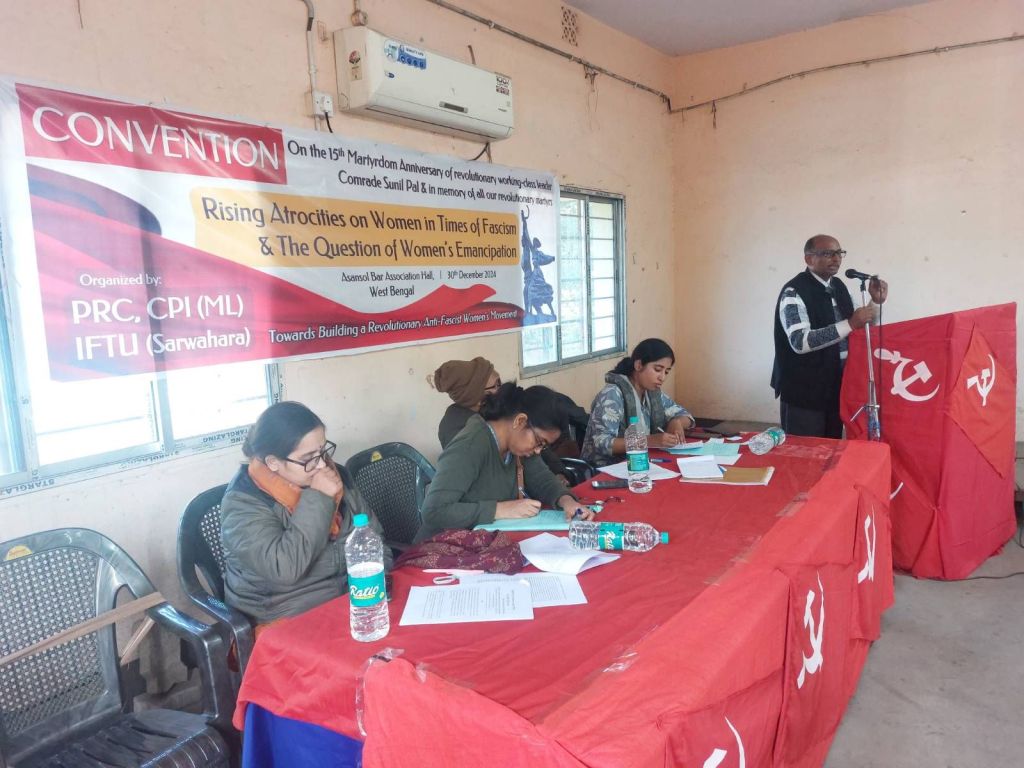
A Convention was organized on the topic “Rising Atrocities on Women in Times of Fascism & The Question of Women’s Emancipation” on 30th December 2024 at Asansol Bar Association Hall in Paschim Bardhaman district of West Bengal by PRC, CPI (ML) & IFTU (Sarwahara), on the occasion of the 15th martyrdom anniversary of revolutionary working-class leader Comrade Sunil Pal.
It was attended by more than 100 delegates including revolutionary activists, trade unionists, intellectuals and workers, along with representatives of 16 revolutionary organisations viz. CPI (ML), CPI (ML) Red Star, CPI (ML) New Democracy, CPI (ML) Mass Line, Proletarian People’s Front, Inquilabi Mazdoor Kendra, Lal Jhanda Mazdoor Union (Samanway Samiti), Chintan Patrika, Manthan Patrika, All India Working Women’s League, Shram Mukti Sangathan, Communist Chetna Kendra, Mazdoor Sahayata Samiti, Shramik Sangram Committee, ECL Theka Shramik Adhikar Union, Asansol Civil Rights Association, Khan Mazdoor Karmchari Union. A total of 12 speakers presented their views on the topic.
The proceedings started with comrade Kanchan’s welcome note and holding a minute of silence in memory of all revolutionary martyrs, followed by a Bengali shaheed geet “Amra kemon kore bhooli go” by Arunoday cultural team. The Presidium then took its place comprising comrades from PRC and IFTUS – Ajay Sinha, Kanhai Barnwal, Akanksha, Vidushi and Kanchan.
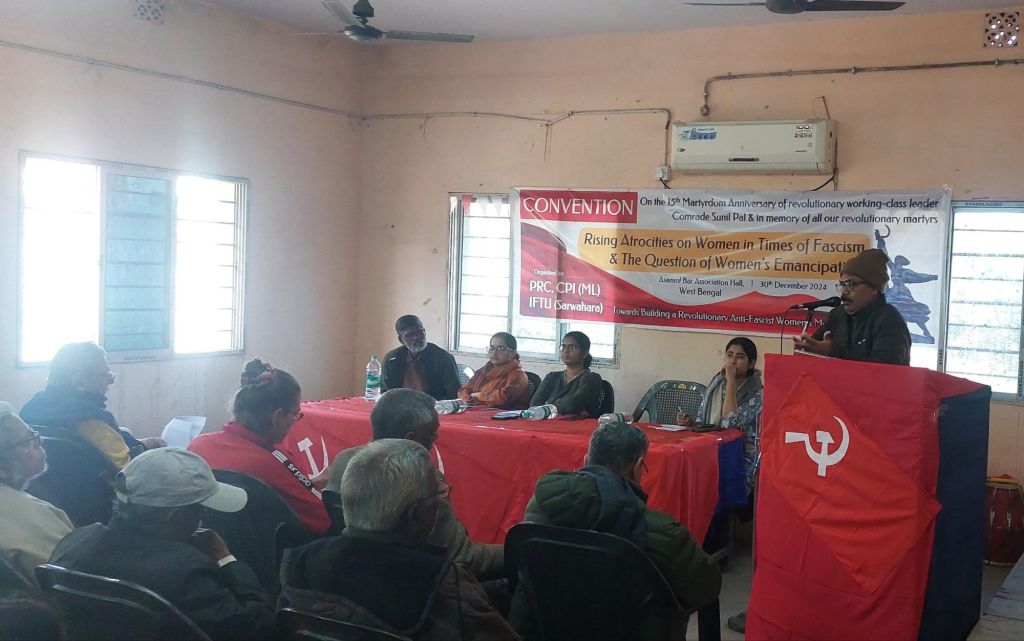

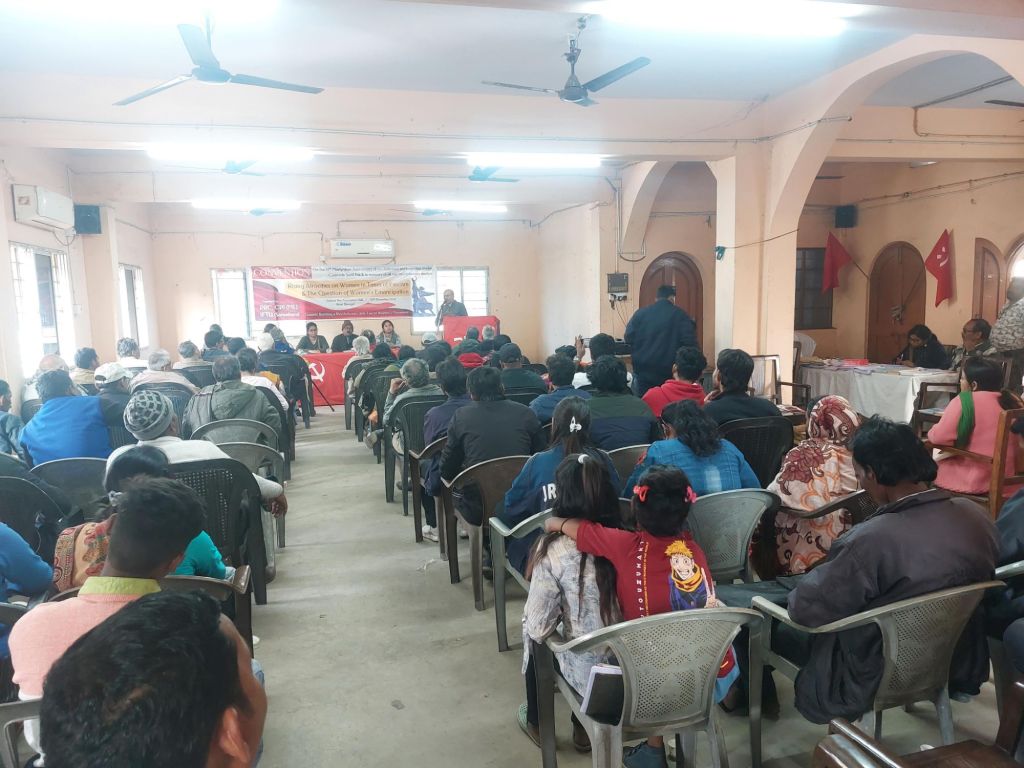

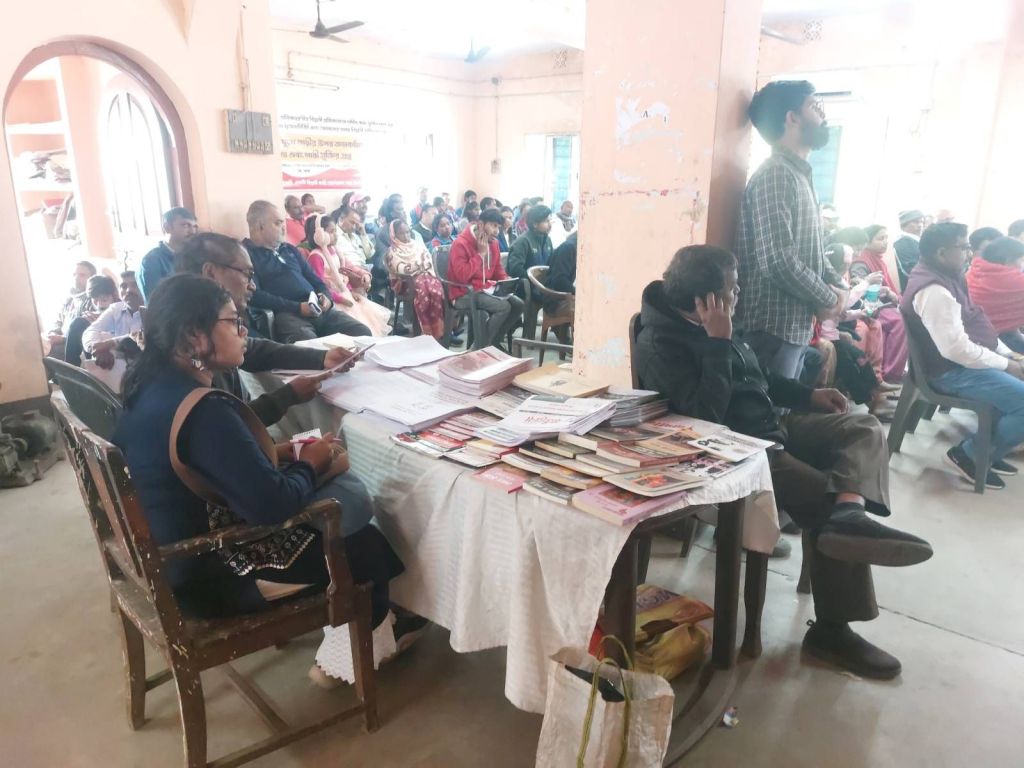

The discussion started with Comrade Ajay Sinha (GS, PRC CPI ML) presenting the base paper on the topic. The paper discusses the interrelation of patriarchy and fascism, both of which are rooted in the current exploitative socio-economic system of capitalism-imperialism, the latter being only the naked form of its class rule serving the interests of the worst elements of finance capital. It emphasizes the growing atrocities on women in the context of the unyielding crisis and decay of capitalism which, by sponsoring a hateful divisive fascist movement on one side and targeting the female body through commodification and exploitation of female sexuality on the other, has promoted an all-round moral-ideological-cultural degradation of society. Drawing on historical examples such as Nazi Germany and fascist Italy, the paper highlights how fascist ideologies reinforce patriarchal structures, relegating women to domestic roles while using them as mere instruments of childbearing and rearing for ‘nationalist’ goals of racial purity and (in India) even caste reassertion.
It further outlines the history of subjugation of women, taking from the studies of Friedrich Engels and August Bebel, as a consequence of the emergence of private property and the patriarchal family structure following the overthrow of mother-right as a result of the inevitable change in mode of production and social life. Through this, it argues that women’s liberation is inseparable from the abolition of private property (and hence, capitalism) and the establishment of socialism; and also critiques the Feminist approach of women’s liberation which, being a bourgeois ideology, doesn’t challenge private property and hence, is unable achieve the goal of liberation. The paper also highlights the limitations of the ongoing and recently passed movements against heinous rape crimes (RG Kar, Nirbhaya etc.) in targeting the socio-economic structures that sustain patriarchy and fascism (i.e. capitalism), and moving beyond mere legal reforms, and calls for a revolutionary path of women’s liberation linked with the overthrow of capitalism and, along with it, patriarchy and fascism.
Click here for the full speech.
Click here to read the full paper.
Soumendu Ganguly from ‘Lal Jhanda Mazdoor Union (SS)’ said that female sexuality has always been a commodity under the bourgeois system. While earlier its consumption was limited to the patriarchal family household, now with the development of bourgeois system it has been turned into a market commodity. He shed light on how in the last century, numerous seminars and action plans were undertaken in the bourgeois world with the aim to abolish prostitution and venereal diseases but it failed to achieve this even after 200 years of bourgeois rule, while Soviet Union was able to achieve this merely 20 years after the Russian Socialist Revolution; and today, when bourgeois system has completely failed, it has resorted to glorification of prostitution, presenting it as a viable employment option for primarily working-class women in the name of freedom. Working class forces must expose this treachery of the ruling class and present its own historical achievements to provide a path towards real emancipation of women. Regarding ongoing women’s movement, he argued that while the anti-patriarchy protests have developed somewhat on the social level since Nirbhaya then to Abhaya now, it is still within the restrictions of bourgeois outlook. When working class forces expose the limitations of this outlook and present a proletarian outlook, we are branded by the feminist forces as supporters of patriarchy. He emphasized that if intervention from working class outlook is not done today then the women’s movement will keep revolving around the bourgeois axis which won’t lead anywhere, let alone emancipation. [Full speech]
Comrade Shankar from ‘CPI (ML) Red Star’ stated that women’s emancipation is not just a tactical question for the working class, but a strategic question without addressing which a communist party cannot be worth its name. He said that the ground for struggle for women’s emancipation had been laid since the overthrow of mother-right and the world historic defeat of female by male after the origin of private property, as was submitted by Engels. Hence, contradiction with respect to women’s emancipation is not just women vs private property (as has been said in the base paper) but female vs male too since, he argued, ‘Female-Male’ and Gender is not just a biological construction but a social one. He emphasized that Feminism has many currents and the current which has been critiqued in the base paper is true for bourgeois liberal Feminism but not Marxist Feminism. Although it’s true that bourgeois feminist elements hold hegemony over recent and ongoing women’s movements which push for ‘apoliticization’ of protests and dilution of ideology for greater mobilization, as can be seen even in ongoing RG Kar protests. Criticizing and ultimately replacing such leadership should be our aim otherwise the movements will suffer from deviations and defeat. He said that bringing working class ideology into women’s movement is imperative since women’s liberation is possible only by the abolition of private property and capitalism, because the contradictions within the modern family are inter-related with all social contradictions and the contradictions within the state. He said that there has been inadequate discussion in the base paper on the basis of Indian fascism i.e. Manuwaad-Brahminism; it becomes necessary to bring it in the question of women’s liberation since in this basis, the status of women and Shudras has been considered equal (without any rights), which is being implemented by the fascists today. He said that in the context of the development of a matrilineal to patriarchal society in Indian history, the Debiprasad Chattopadhyay-Kosambi Theorem is more relevant and accurate than the Morgan-Engels Theorem (discussed in the base paper), which shows this development taking place in a zigzag pattern instead of a linear one. He said that the experiment being conducted in Rojava (Kurdistan) is noteworthy even with all criticisms and it should be discussed in the context of today’s topic. [Full speech]
Comrade Munmun from ‘Chintan’ Magazine stated that Fascism has its relationship with the women’s question, and while this question has been important in the communist movement, we haven’t yet developed the understanding up to the contemporary mark. Still we go on narrating Engels’ work solely while it has its own limitations, and our conclusion remains that women question will dissolve with the dissolution of private property in general, and patriarchy will abolish immediately under proletarian dictatorship. In this context, various Marxists’ works on Marx’s Ethnological Notebook, which is now available, are relevant. The paper placed by PRC leads us to the same disappointment in the last part, although it has a good start by identifying some debates and elaboration on why fascism is more atrocious to women. The paper states something like pornography and distorted sexuality introduced by market as being the cause of rising rapes and murders. A similar debate was initiated after the Nirbhaya incident ten years back, on whether power or sexuality should be accused of increasing violence against women in metro cities. It should not be forgotten that power position also provides audacity to rape. In RG Kar, the power position of the Institute’s authority played the same role. The main limitation of the paper may be that it couldn’t elaborate anything about the potential of the women subjects in this fight against fascism. We as part of communist movement are only talking about Soviet Russia, and the decrees it had adopted for the liberation of women 100 years back. In between women have experienced a lot and contributed to the society with their labour, intellect and creativity, even after bearing the double burden. Bourgeois Feminism has its own limitations, but it can attract women by recognising their role. A number of literature have become popular addressing women’s plight within society under this umbrella of Feminism. This is also the time to think- whether utter rejection of Feminism could be beneficial for the working class axis, or we need to invest more to understand the subjective experience of women within the communist movement and develop our own proletarian axis of women’s question. Two earlier speakers have mentioned some bourgeois feminist features of the RG Kar movement, but those are not its only features. Women have hatefully rejected the protectionist viewpoint of the state regarding nights. Reclaim the nights and reclaim the rights movement has ended all confusion that women should have equal occupation on all the night spaces. The reason for their insecurity is to be abolished. Another important aspect of the RG Kar movement is that it has rejected fascist RSS-BJP in the first place, since women’s issues are at the forefront. We should explore the potentials favourable to the proletarian axis, without being crudely puritan. One more aspect an earlier speaker has raised was that prostitution being named as sex work by bourgeois feminists is derogatory to women’s modesty. I believe we should demand decriminalisation of prostitution first instead of its legalisation as it is being done in favour of capital, because we should know which women are in prostitution under what precarious circumstances, and once they become prostitutes they are treated as criminals without any human rights. Lastly, women’s issues won’t be resolved immediately after ‘socialism’. Having progressive decrees from above could not change anything even in Soviet Russia in the long run. Subjective potential of women’s agency needs to be addressed in every sphere and every stage of the struggle for socialism. [Full speech]
Comrade Alok Mukherjee from CPI (ML) shed light on the history and class character of fascism linking it with the deep crisis of capitalism and particularly of the big bourgeoisie. He delved on the development and consolidation of fascist rule in Nazi Germany and Mussolini’s Italy, and discussed the differences in socio-political conditions then and now that have emerged post World War 2 – the creation of welfare states and their subsequent dismantling post the 1960s crises – and advent of neoliberalism, which caused a new emergence of fascism in countries in India. He also presented statistics to show how neoliberal policies has disadvantaged women in employment and social life. On Feminism, he highlighted that there are some non-bourgeois currents in it which are closer to the Marxist viewpoint. [Full speech]

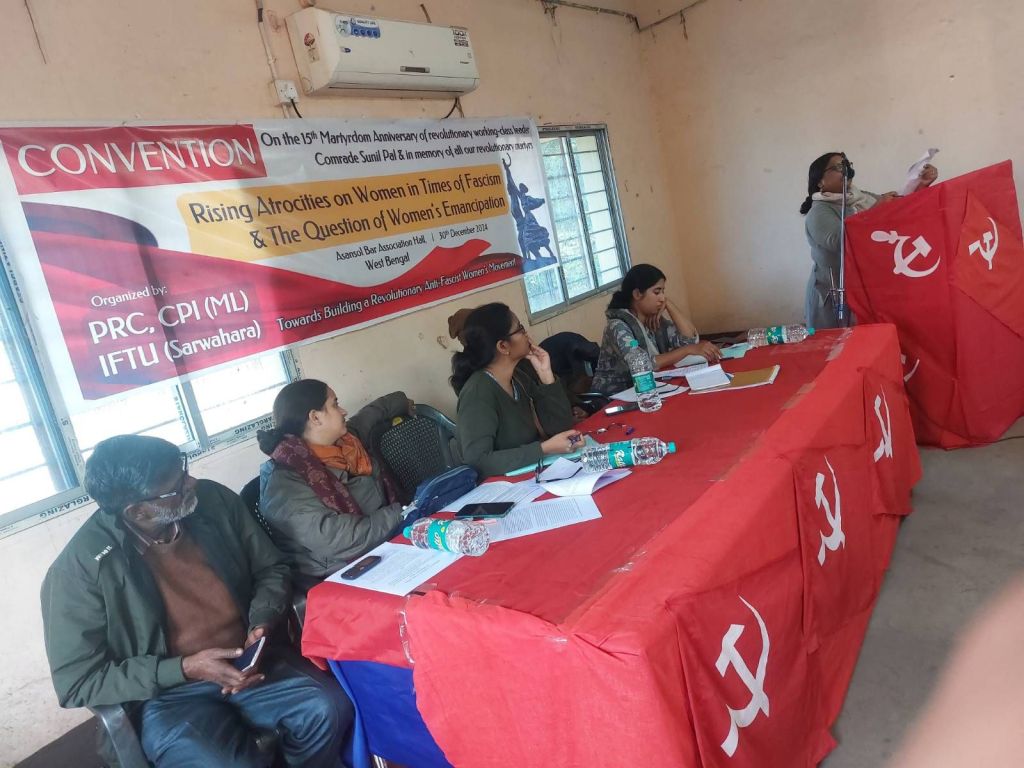
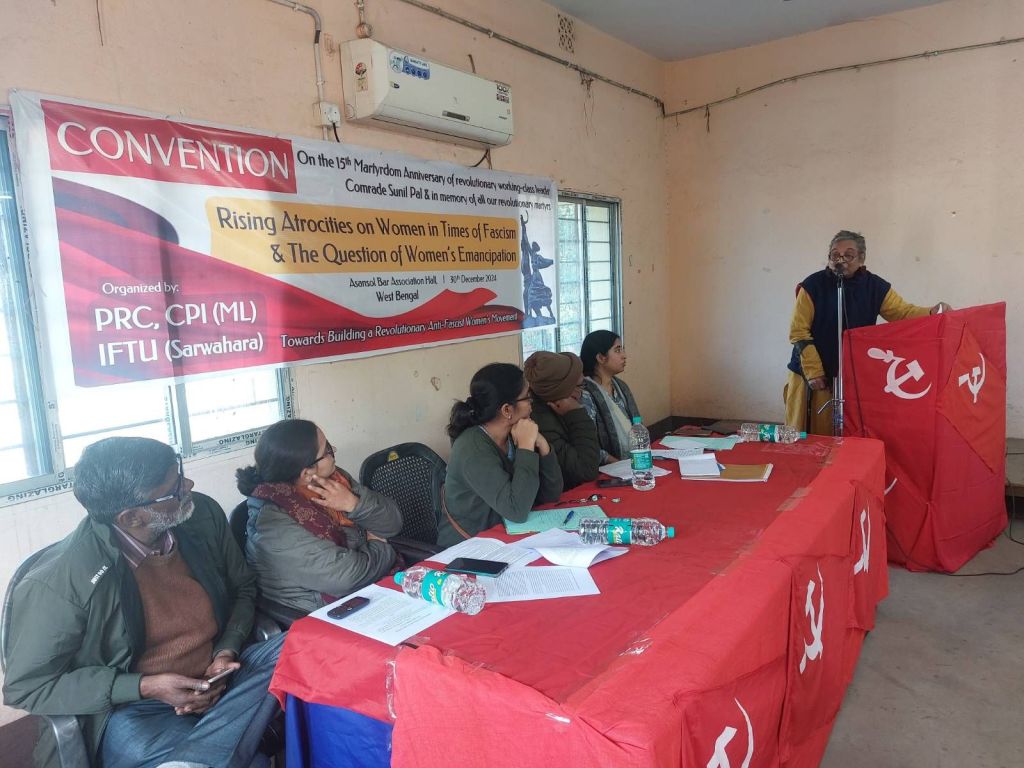


Comrade Shivani from ‘All India Working Women’s League’ discussed the characteristics of a fascist regime and how it progresses in stages to consolidate its rule, drawing parallels from examples in history to the conditions in India today. She said fascism believes in complete subjugation of women and their relegation into patriarchal family structure as was seen in Nazi Germany with the slogan ‘Kinder, Küche, Kirche’ (Children, Kitchen, and Church) and that women’s lives should revolve only around these three. She highlighted the class division present within women and that women of different classes (bourgeois or proletarian) have different and often opposing interests and that the proletarian women interests align with the historical mission of the working class. In the end, she listed some immediate demands which must be raised by women’s and workers’ movement in order to mobilize women in the struggle against fascism and capitalism. [Full speech]
Comrade Om Prakash from ‘Manthan’ Magazine reiterated that women’s liberation is linked to the liberation of working class, asserting that attacking patriarchy without linking it with overthrow of capitalism, as Feminism does, will rather be beneficial for capitalism. He linked the commodification and objectification of women through an encompassing advertisement culture of capitalism with the moral-cultural degradation in society leading to rising crimes against women, which the feminism advocates in the name of freedom. He highlighted the different and often opposing interests of different classes of women, like those of a domestic worker and her female employer, and called for a class analysis when dealing with this question of women liberation. He also emphasized that it would be wrong to link fascism only with BJP today since all ruling class parties (including Congress and local parties) serve the interests of capitalism-imperialism and hence promote fascism. In the end, he asserted that rule of private property must be overthrown for liberation of women and all ‘isms’ perpetuated by the ruling classes (casteism, communalism, racism, dalitism, feminism etc.) must be opposed with a proletarian perspective. [Full speech]
Comrade Ram Lakhan from ‘Communist Chetna Kendra’ said that all forms of oppression and exploitation, including that of women, emanate from the capitalist system, and the struggles of all sections of the masses must be linked with the overthrow of this system in order to achieve their emancipation. He highlighted how both the Communist Party of India and the RSS were founded in 1925 but today, after a century, the fascists have become stronger than ever and are ruling while we the communists are divided and weak, and this is primarily because of ideological disarmament of the working class. He called for all revolutionary groups to set aside their differences in order to unitedly launch an ideological movement across the country centering on socialism-communism. [Full speech]
Comrade Mukesh Aseem from ‘Proletarian People’s Front’ discussed how the bourgeoisie introduced the ideals of liberty, equality and humanism with its emergence in history, and how, after the subsequent emergence of the revolutionary proletariat and its class struggle for emancipation to actually realize those ideals post 1840s, the same bourgeoisie went back on its own high-sounding slogans in order to crush the proletariat and establish ‘order’ in the society. This shift was also evident in literature, arts, and philosophy of the bourgeois class which caused the emergence of reactionary forces and philosophers like Nietzsche. These reactionary forces are sponsored and enabled to take state power as per the need of the crisis-ridden monopoly capitalists to crush the aspirations and struggles of broad masses, as was seen in Italy and Germany in 20th century. This merger of the interests of the worst elements of monopoly finance capital and highly reactionary forces gives rise to fascism, in which all historical forms of oppression get manifested. On women’s question, he said that two opposing bourgeois currents are often presented before us – one liberal alternative advocating bourgeois freedom (to sell oneself in the market) and one fascist alternative restricting women into households. These two alternatives suppress the proletarian alternative for real emancipation of women which needs to be boldly brought out. He stated that bourgeois feminism today has become advocate for imperialism and war. In the end, he said that while it’s true only with the abolition of private property will women’s emancipation be possible, it’s still a long-term and abstract call. The working class must provide the masses with a concrete intermediate call too to fight patriarchy, fascism and capitalism today, which is to take up the fight for democracy against fascist forces in a manner which goes towards ousting the forces of fascism and finance capital from power and establishing a genuine people’s government free from their influence that will not merely ‘save’ this democracy but further expand its horizons. [Full speech]

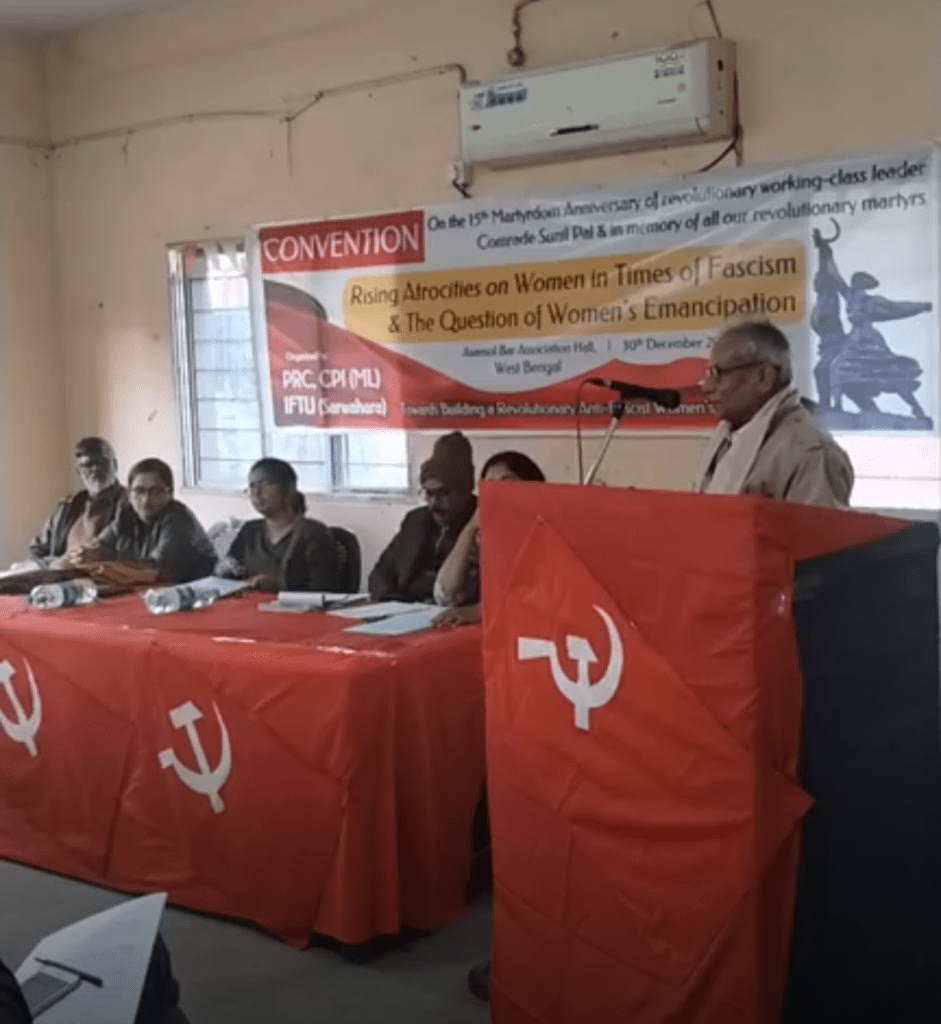
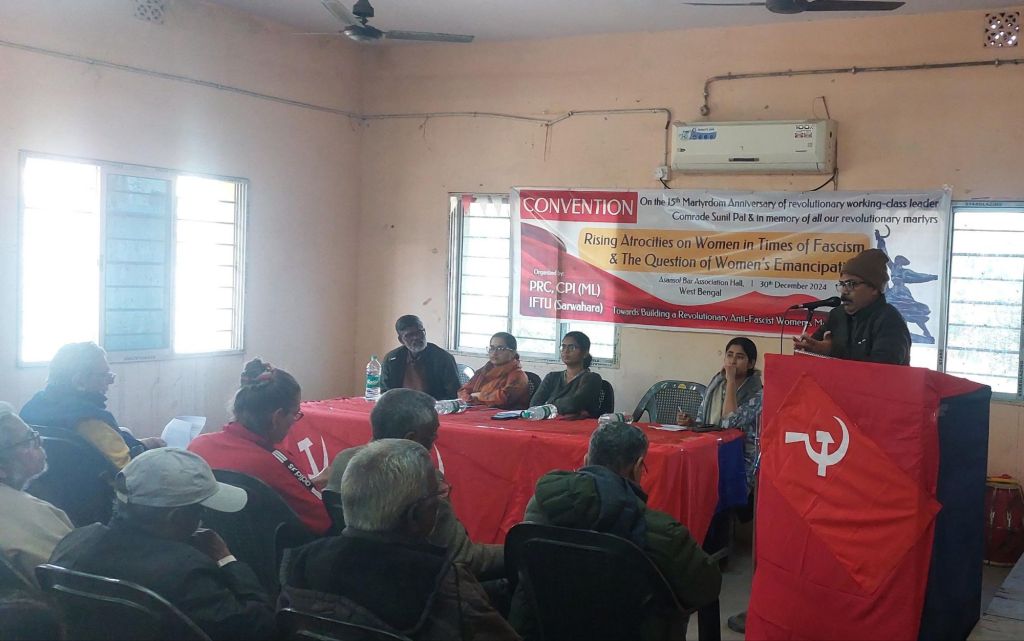
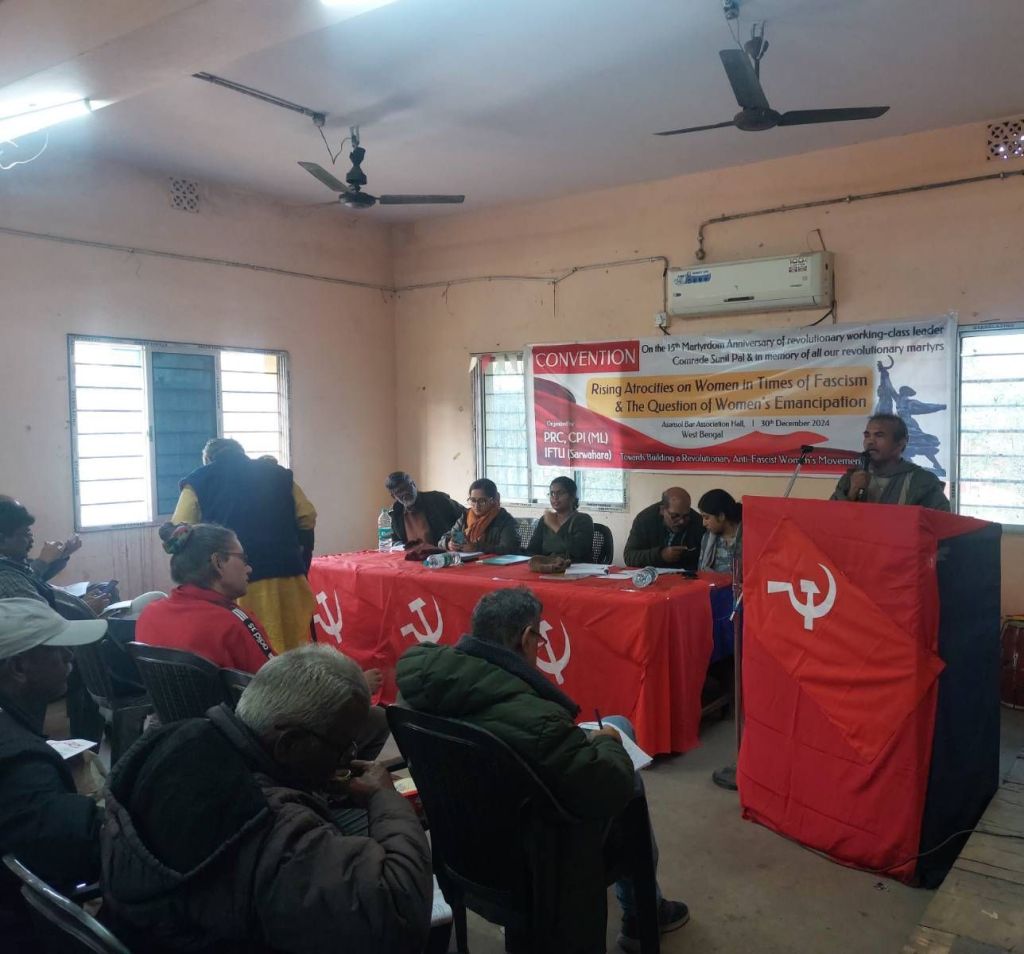
Comrade Jai Prakash from ‘Shram Mukti Sangathan’ said that atrocities against women emanate from the anti-women outlook of the ruling classes in society which view women either as a childbearing machine or as a sex object. He emphasized that capitalism today has only intensified the oppression on women since it requires women to work as housewives in order to prepare the male worker for the next day and to bear and rear the next generation of workers, but it keeps this work in the private realm of an individual family and thus doesn’t allow women at large to participate in social production. In addition, it commodifies women and reduces them into mere sex objects through porn and entertainment industry. He highlighted the contradiction within capitalism that what had to be social (women’s role in production) and public (protest demonstrations) is kept private and restricted, and what had to be private (sexual relations) is made public (through pornography and prostitution), all for profit maximization. He reiterated that emancipation of women is possible only through abolition of private property which will allow them to take active part in social mode of production (like, through factory kitchens). He asserted that Feminism is inherently a bourgeois ideology and there can be no such thing as proletarian feminism given its bourgeois character, just like there can be no proletarian dalitism or proletarian nationalism, and it has no path for liberation of women. [Full speech]
Comrade Shyambir from ‘Inquilabi Mazdoor Kendra’ said that the deepening crisis of capitalism has led to consistent dismantling of the rights and protections it once provided under the welfare state model, which is directly in the interests of monopoly capital. In India, the monopoly capitalists have backed the party they saw most suitable to further their interests – the BJP-RSS which aspires to create Hindu Rashtra and Akhand Bharat, which also aligns with the aspirations of monopoly capital, and propagate barbaric medieval ideals in society. He argued that in today’s class society, interests of women also align with their class. He cited 3 child rape-murder cases in Gurgaon in 2017-18 in which the victims belonged to working-class families and, despite protests and memorandums, it failed to garner any mass-support or sympathy; he also cited how working-class women face harassment and assault at workplaces on a daily basis which often goes unnoticed. He stated that in this era of liberalization, factories are functioning as a state-in-itself untouched by the law of the land. He emphasized that political and social rights of women were implemented not with the advent of capitalism but after the 1917 Russian Socialist Revolution and today, decaying bourgeois democracy has nothing to provide to the masses and the path of women’s liberation is essentially linked with the working-class revolution. Regarding fascism, he argued that given the control and consolidation of fascists over the state machinery today, it can be defeated only through struggles of the working class and toiling masses on the streets. [Full speech]
Comrade Ashish Dasgupta from ‘CPI (ML) New Democracy’ said that the Indian fascists led by RSS have four major targets for oppression – workers, dalits, adivasis and women, since they are guided by Manusmriti which has equated women to slaves. He gave an appeal to the Presidium to include a paragraph on Manusmriti in the base paper in the context of rising Fascism in India. He mentioned how with the growing influence of finance capital in society, conditions for broad masses are consistently deteriorating; labour Codes are being implemented informally in factories and women workers face unprecedented exploitation and oppression from small factories to even the IT sector, but they can’t even raise their voice in the fear of losing their employment. He said that their organisation will further study the Convention’s base paper and take forward this important discourse. [Full speech]
Comrade Priyam Basu from ‘CPI (ML) Mass Line’ sent a message expressing regret for not being able to participate in the Convention but wishing for its success and hoping to exchange their views in the future on women’s emancipation which they consider to be a part of the New Democratic Revolution and a question which needs to be deliberated upon seriously.
After all the speeches, Comrade Ajay Sinha presented a sum-up and conclusion to this round of discussion. On Feminism, he said that as far as feminist movements fight for equality between men and women as well as for reforms, we believe it is a justified fight and we can create a fighting unity with it on these grounds; but our approach in fighting for reforms under capitalism is to expose that despite reforms subjugation doesn’t get abolished and hence fight against capitalism is imperative. Against fascism, broad unity of various fighting currents is needed but the condition for any strategic unity must be an anti-capital stand, which Feminism doesn’t fulfil today. When the working class movement and working women’s movement will rise, it will inevitably cause a split in the Feminist movement, a section of which will move closer to the proletarian outlook. Capitalism today has not only commodified women’s bodies but increased its demands to an extent which can’t be fulfilled with the traditional measures in society (marriage and prostitution) and hence, gruesome rapes, even on children, are rising. On question of strategy, the revolutionary movement today tends to begin with assessment of our allies (farmers, petty bourgeoisie etc.) which is wrong; we must begin with the working class and boldly put forward its emancipatory role not only for itself but for whole humanity, otherwise we would be doomed to only tail behind these allies. Revolutionary spontaneity among women (and broad masses) will erupt only when they will believe that their emancipation is truly linked with the final struggle of the working class; this should be a point of our focus. On Fascism, the struggle to oust the fascists from state and society will require nothing less than a revolutionary fight of the broad masses led by the working class that can either take the form of dictatorship of the proletariat or more likely, an interim revolutionary government independent of elements of big capital. The growing resentment among masses due to pro-corporate policies and sharpening contradictions among ruling class parties might soon cause storms in society and the working class must be ready to play a decisive role in it in above light, definitely intervening from below through movements but also not leaving the space above to be filled by bourgeois alternatives (like Congress or INDIA Alliance).
In the end, on behalf of PRC, he praised the discourse, claiming that it has certainly benefitted them, and promised to organize a higher platform for this discourse with adequate time for each speaker to fully present their views. [Full speech]
Two working-class activists – Umesh Nirala, a construction worker, and Raju, a factory worker – presented progressive folk songs – “Muh si ke ab ji na paaungi” on women’s struggle against subjugation, and “Paapi dushmanva lihal sunil pal ke janwa” on Comrade Pal’s martyrdom. The Convention was concluded with loud sloganeering of “Inquilab Zindabad, Punjiwaad Samrajyawaad Faasiwaad Murdabad, Pitrisatta Jaativaad Murdabad, Krantikari Shaheedo ko Lal Salam!” followed with the Urdu recital of “The Internationale”.
With revolutionary regards,
Proletarian Reorganizing Committee, CPI (ML)
Indian Federation of Trade Unions (Sarwahara)
 Sarwahara
2 thoughts on “Convention on Atrocities on Women Under Fascism & Their Emancipation Organized in Asansol by PRC & IFTUS”